eBay Motors: Parts, Cars, more
- 4.0
- Rating
- 1.00M
- Installs
- Free
- Price

 Analysis by App-foxy
Shopping for vehicle parts online is rarely as simple as finding a familiar product photo and pressing buy. Fitment, condition, seller reputation, delivery timing, and the difference between an original component and a replacement can all change whether a purchase is genuinely useful. I found eBay Motors: Parts, Cars, more most valuable when I treated it as a focused vehicle marketplace rather than a general shopping app. It brings cars, parts, accessories, and enthusiast-oriented listings into one place, but it still rewards careful checking before any money changes hands.
The app is developed by eBay Mobile and belongs to the Auto & Vehicles category. It is free to install, carries a Teen content rating, and supports devices running Android 8.1 or later. The current version is 4.42.0, while its release date was December 9, 2019. With more than a million installs, it has clearly found an audience among people who prefer browsing vehicle-related listings from a phone instead of relying only on desktop searches or local classifieds.
How I Decide Whether It Is the Right Vehicle Marketplace
My first decision criterion is the kind of purchase I am making. If I need a small, clearly identifiable item—such as a replacement trim piece, a switch, a wheel accessory, or a maintenance component—an app like this can make comparison much easier than visiting several specialist sites. If I am looking for a complete car, a rare part, or something used and difficult to source locally, the wider marketplace becomes even more useful.
You May Also Like

 Blood Strike: 2.5 Anniversary
Blood Strike’s Loadouts Turn Every Drop Into a Tactical Gamble
A close look at Blood Strike’s custom loadouts: how fast access to signature weapons reshapes its battle royale rhythm, rewards preparation, and narrows the gap between fights.

 Pandora - Music & Podcasts
Pandora’s Music Is Easy to Start, but Harder to Recover
Pandora’s strength is its low-effort path from a seed to a station. Its weak spot is how much confidence it asks you to place in connection, setup, and quiet recovery.

 8 Ball Pool
 Is Built on Rivalries, Rematches, and Routine
A close look at the rivalries, rematches, shared routines, and unanswered safety questions that turn a quick pool match into a persistent mobile community.

 Samsung Music
’s Quiet Strength Is Playing What You Already Own
Its reach comes less from spectacle than from dependable access to a personal library. That simplicity is both the app’s strongest retention engine and its ceiling.

 AccuWeather: Weather Radar
AccuWeather Review: A Quick, Clear Forecast for Everyday Decisions
For everyday plans, the best forecast is the one you can understand quickly. AccuWeather makes rain timing, radar, and local conditions easy to act on, with a few trade-offs.

 Hill Climb Racing
Why Hill Climb Racing Still Turns Crashes Into One More Run
A tiny car, a bumpy hill and one more upgrade: Hill Climb Racing keeps resurfacing because its simple chaos makes every near-miss feel personal.
More From Our News Desk
View All News


The second criterion is how much verification I am willing to do myself. This is not an app that removes the need to understand a vehicle. It helps me discover listings, compare options, and contact the marketplace experience through a mobile interface, but I still need to read descriptions closely. A part that looks right in a photograph may belong to another model year, trim, engine, or market. For me, the app works best when I already know the vehicle identification details or have a mechanic’s part reference ready.
I also consider urgency. For a repair that keeps a car off the road, I would not choose an unfamiliar listing simply because it appears first. I would compare the stated condition, seller information, delivery expectations, and return details before deciding. The app is excellent for widening the search, but speed should not replace verification. A cheap wrong part is not a bargain if it causes another delay.
Another practical question is whether I want new, used, original, aftermarket, or collectible equipment. Vehicle marketplaces often contain several versions of what seems to be the same item. That variety is one of the strongest reasons to use this app, but it is also where careless browsing can become expensive. I found it helpful to decide the acceptable condition and brand before searching, rather than letting the first attractive image set my expectations.
The app’s overall rating sits at 4.0 from roughly 6,400 ratings, with about 1,900 written reviews. I read that as a solid but not flawless signal: many people find the service useful, while the final experience can depend heavily on the individual listing and seller. That distinction matters more here than it would in an app where every user receives the same fixed service.
Searching with a mechanic’s mindset
My best results came from searching with more than a casual description. Instead of entering only “brake part” or “car mirror,” I used the vehicle’s make, model, year, side, body style, and the exact component name whenever I knew them. I then compared the wording in several listings. Repeated details can reveal whether sellers are describing the same specification or merely using similar photographs.
A useful habit is to open the entire description before judging the price. The main image may show a clean component, while the text explains that it is used, missing a mounting clip, painted for another vehicle, or sold without an accessory. I also look for photographs of connectors, labels, mounting points, and wear areas. Those details are often more useful than a polished front-facing image.
For a complete vehicle, I would use the app as a research and contact tool rather than as a substitute for an inspection. I would compare several listings, note the mileage and condition language, and ask direct questions about service history, title status, known faults, and what is included. If the seller avoids specific answers, the convenience of the app does not compensate for the risk.
Where the app wins against ordinary alternatives
The biggest advantage is concentration. Instead of checking a general classifieds app for cars, a parts retailer for new components, and enthusiast forums for unusual items, I can begin in one vehicle-focused environment. That does not guarantee the best listing, but it makes the discovery stage faster and gives me a broader view of what is available.
It is particularly strong for mixed searches. I might begin looking for a replacement part and then discover compatible accessories, used assemblies, or a complete vehicle related to the same project. For someone restoring a car or maintaining an older model, that breadth can be more useful than a narrowly specialized catalog that carries only new stock.
I also like the way a marketplace encourages comparison between condition and price. A new aftermarket item, a used original component, and a refurbished assembly may all appear in the same search area. That lets me make a practical decision based on budget and purpose. For a daily driver, I may prefer a dependable replacement. For a restoration, an original used piece may matter more than a perfectly new reproduction.
The enthusiast angle is important too. The store summary describes the service as being made by enthusiasts for enthusiasts, and I understand why that positioning fits. Vehicle shopping often involves details that ordinary product categories do not handle well: left versus right, front versus rear, generation changes, engine variants, cosmetic condition, and compatibility with a particular project. The app feels most useful when I approach it with that level of attention.
Three workflows that make it more useful
My first practical workflow is to build a short comparison set instead of buying the first result. I save or note a few candidates, then compare the actual part number, condition, included hardware, seller description, and delivery terms. This reduces the chance of choosing a visually similar item that is incomplete. It also makes a slightly more expensive listing easier to justify when it includes the bracket, sensor, key, or other piece I would otherwise need to source separately.
The second workflow is to search by the component’s identifying mark when possible. Images can be misleading, especially for common body and interior parts. A label, casting number, or manufacturer reference gives me a better starting point. I still verify the match with the seller, but this approach narrows the search more effectively than relying on a broad vehicle name alone.
The third is to use the app before I need the part urgently. When a vehicle is already disabled, I am more likely to overlook an unclear description or accept an unsuitable delivery window. Browsing in advance helps me learn the normal range of conditions and identify which details sellers usually provide. For an older car, I would rather understand the market before the repair becomes an emergency.
A realistic example would be a weekend repair on a family vehicle. I might discover that the exact replacement mirror is available in several colors and conditions. The least expensive option could require painting, while a higher-priced used unit might already match the car and include the mounting hardware. After adding the likely extra work and waiting time, the second listing could be the better decision even if its headline price is higher. This is where the app helps: not by making the choice automatically, but by showing the trade-offs in one browsing session.
Where a different category of alternative may fit better
I would choose a dedicated auto-parts retailer when I need a routine maintenance item with predictable compatibility, a clear warranty structure, and a straightforward new-product purchase. A specialist catalog may be less interesting for rare discoveries, but it can be easier when I know the exact component and want a simple replacement process.
A local parts store is often better when the car is needed immediately. I can speak to someone, compare the old component in person, and avoid waiting for delivery. The app is more useful when local stock is limited, the part is unusual, or I have time to compare used and new choices.
For buying a complete car, local dealers or established vehicle marketplaces may be more suitable when I want a test drive, financing discussion, trade-in process, or in-person inspection. This app can broaden the search and expose me to enthusiast and private listings, but I would not treat a phone listing as proof of mechanical condition.
Enthusiast forums and owner groups can also be better for technical advice. They may help identify a revision change, a common failure point, or an obscure compatibility issue before I shop. I see those communities as a useful research companion rather than a direct replacement for this app. The marketplace is where I look for available items; specialist discussion is where I try to understand what I should actually buy.
Friction, risk, and the real cost of switching
The main limitation is the amount of judgment the app leaves with me. A broad marketplace can contain excellent finds, but it can also contain vague descriptions, incomplete photos, inconsistent terminology, and listings that require follow-up questions. I need patience, especially when a component affects safety or when the part is expensive.
There is also a learning cost if I am new to vehicle maintenance. I may need to identify the exact generation, confirm whether a part is for the driver or passenger side, and understand whether an assembly includes the related electronics or hardware. The app does not make that knowledge unnecessary. For a first-time buyer, a trusted mechanic or parts specialist may save more time than a large search result.
Switching from a local store to an online marketplace can also change the nature of the purchase. I may save time by avoiding several physical visits, but I take on the responsibility of checking photos, reading seller terms, monitoring delivery, and handling a return if the item is wrong. Switching from a specialist retailer has a different cost: I may gain access to used or rare parts, but I may lose the simplicity of a standardized catalog.
Privacy and account comfort are personal considerations too. Some users will appreciate having vehicle shopping organized in a familiar marketplace environment, while others will prefer a retailer whose entire experience is dedicated to automotive parts. I would choose based on how often I shop for vehicle items and how comfortable I am managing marketplace-style purchases from a phone.
The app is free, which makes trying it low risk from an installation standpoint. That does not mean every purchase is low risk. The meaningful cost is the item itself, possible shipping, installation, paintwork, missing hardware, or the time spent correcting a bad match. I always calculate the complete job rather than comparing only the listing prices.
Who should use it and who should skip it
I recommend it to DIY owners, collectors, restorers, drivers maintaining older vehicles, and shoppers who need access to a wide range of vehicle-related listings. It is especially appealing if I am comfortable comparing condition and asking precise questions. The app’s audience is not limited to people buying cars; its parts and accessory marketplace is the more compelling reason for many users to keep it installed.
I would be cautious about recommending it to someone who wants a guaranteed fit with no research. If I cannot identify the required part, do not understand the difference between used and refurbished condition, or need the vehicle repaired today, a local specialist may be the safer choice. I would also skip marketplace hunting for critical components when the seller cannot provide enough information to establish compatibility and condition.
For casual browsing, the app can be enjoyable because vehicle searches often lead to unexpected discoveries. For a serious purchase, I treat that browsing freedom as a starting point, not a reason to rush. The strongest users are those who can turn a large selection into a disciplined shortlist.
My recommendation after using it
My recommendation is positive, with an important qualification: use the app as a vehicle research and comparison workspace, not as an automatic guarantee that every listing is right for your car. It earns its place on my phone because it combines cars, parts, and enthusiast-oriented searches in a way that is difficult to reproduce with only a local store or a narrow parts catalog.
The app is free, runs on relatively older Android versions, and has enough adoption to feel like a practical marketplace rather than a niche experiment. Its 4.0 average shows a generally favorable reception without suggesting that every transaction will be perfect. I would begin with it when searching for a hard-to-find component, comparing original and aftermarket choices, or exploring a vehicle project.
Before ordering, I would confirm the exact fitment, inspect every photograph, read the condition language, check what hardware is included, and ask the seller a direct question when anything is unclear. For safety-related or expensive purchases, I would add a mechanic’s opinion or an in-person inspection. Those steps take a little effort, but they turn the app’s broad selection into a real advantage.
In short, I see eBay Motors: Parts, Cars, more as the best choice for informed shoppers who value variety and are willing to verify details. It is less suitable for people who want a completely guided purchase or immediate local pickup. If you enjoy solving vehicle-sourcing problems and comparing several possible routes, I would recommend giving it a try; if certainty and speed matter more than selection, a dedicated retailer or local specialist may serve you better.
FAQs for eBay Motors: Parts, Cars, more
01What features does eBay Motors offer for finding parts and vehicles?
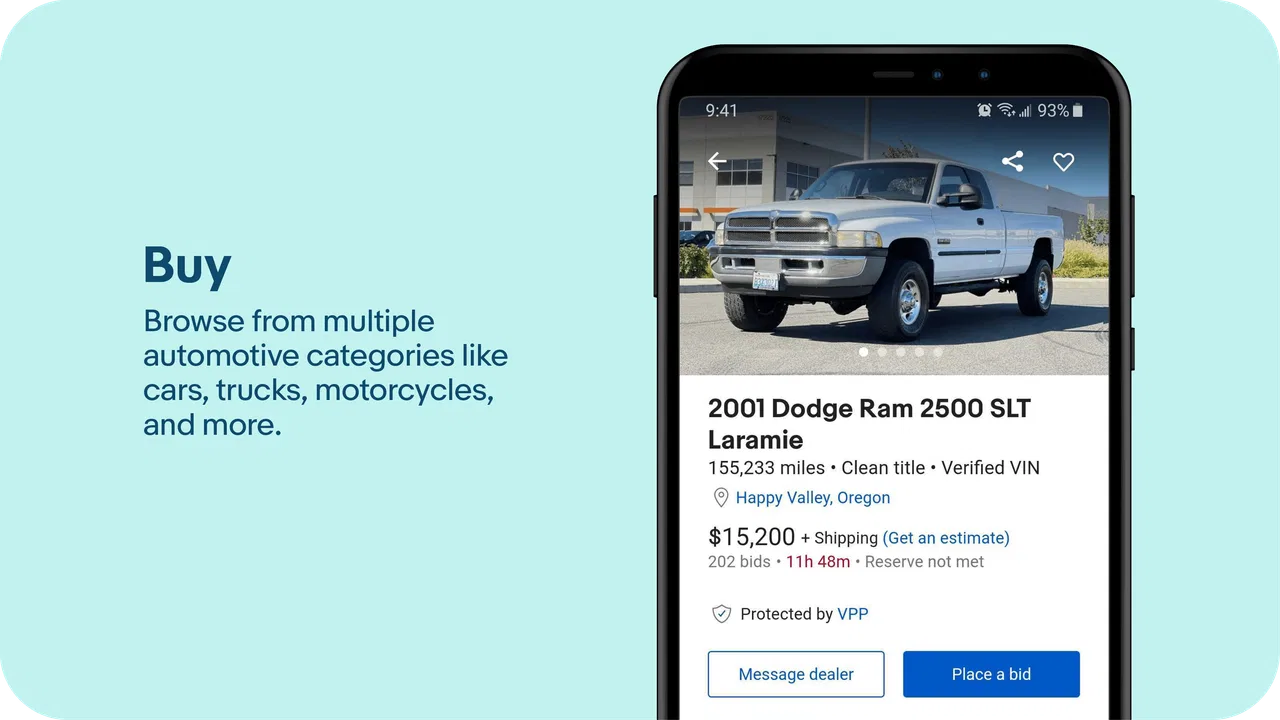
eBay Motors provides a comprehensive platform for searching and buying car parts, vehicles, and accessories. Users can filter searches by make, model, year, and part type. Additionally, the app offers detailed listings, reviews, and a secure purchasing process, ensuring a seamless experience for automotive enthusiasts and professionals alike.
02Is eBay Motors safe for purchasing vehicles and parts?
Yes, eBay Motors is designed to be a secure marketplace for buying and selling vehicles and parts. It includes buyer protection policies, ensuring transactions are safe and reliable. Users are encouraged to check seller ratings and reviews, and eBay's customer support is available to assist with any issues that may arise during the transaction.
03Can I sell my car or parts on eBay Motors using the app?
Absolutely, eBay Motors allows users to sell cars and parts directly through the app. Sellers can create detailed listings with photos, descriptions, and pricing. The app also offers tools to help manage listings and communicate with potential buyers, making the selling process efficient and straightforward.
04How does eBay Motors handle shipping and delivery?
eBay Motors facilitates shipping by providing options and guidance for sellers to arrange delivery. Buyers can see shipping costs and delivery times in listings, and some sellers offer local pickup. It's important for both buyers and sellers to communicate about shipping preferences and arrangements to ensure a smooth transaction.
05Are there any fees associated with using eBay Motors?
While browsing and searching on eBay Motors is free, there are fees associated with selling. Sellers may incur listing fees and final value fees once an item is sold. It's advisable to review eBay's fee structure before listing items to understand potential costs. Buyers typically do not pay any additional fees beyond the purchase price and shipping.
Pros
- User-friendly interface for easy navigation.
- Wide range of car parts and vehicles available.
- Detailed listings with photos and descriptions.
- Secure payment options for safe transactions.
- Efficient search filters to find specific items.
Cons
- Some listings may have misleading descriptions.
- Occasional app crashes during use.
- Limited customer service for dispute resolution.
- Inconsistent shipping times from sellers.
- High shipping costs for certain items.

eBay Motors: Parts, Cars, more
Gallery